Friday, 15 October 2010

Blog Action Day 2010: Water in Tanzania

Today is Blog Action Day 2010, and thousands of bloggers all over the world are blogging to draw global attention to the vital human right to safe, clean water. It is appropriate that we -- CPAR Tanzania -- should be blogging about water today because as we speak community members of Kerekekere village are accessing borehole water for the first time ever, and we have commenced drilling of another borehole at Haruzale village.


Members of Kerekekere Water Committee training in borehole maintenance


First borehole water at Kerekekere
Water is a huge challenge in rural Tanzania, so we've been taking a variety of approaches to supporting communities to meet their water requirements. This includes construction of rainwater harvesting tanks in primary schools; micro-irrigation schemes for women's vegetable and fruit gardening; and most recently support for community boreholes.

Words don't do justice when describing the kinds of water sources people are forced to turn to for their daily needs of drinking, cooking, bathing, handwashing, doing dishes and washing clothes. So, here are some shots...


Fetching water for home use
 
School kids fetching drinking water

Washing dishes and bathing in Lake Victoria
We are committed to supporting community solutions to water challenges and, as long as we can continue to obtain funding (the challenge of every non-profit organization), we will keep plugging away at the local level and telling you about it on this blog.
School kids drinking rainwater
In the meantime -- don't waste water, be grateful for the luxury of drinking from the tap and please feel free to donate to CPAR Tanzania through our website at Canadian Physicians for Aid and Relief 

Friday, 24 September 2010

Boreholes in Bunda!


We have ventured into new territory. After six years of building rainwater harvesting infrastructure in primary schools in Karatu District, we are taking a different approach to address water challenges in Bunda District. Subsequent to hydrogeological and environmental assessments of Bunda, located in the Lake Victoria watershed, boreholes (deep water wells) are found to be a feasible solution to water problems faced by our project communities.

Karukekere village is a farming community about 8 km from Lake Victoria which is the largest lake in Africa, divided up among Kenya, Uganda and Tanzania. (As a point of interest, the White Nile flows out of Lake Victoria at Jinja, Uganda.) Karukekere community members have depended on seasonal sloughs and water from the lake -- both contaminated -- to meet their water needs.

As Japhet, Nderingo and Elizabeth were on hand in Karukekere, pretty stressed out as we all waited for the drillers to strike 'gold', all of a sudden water erupted (see the photo above). Actually, any water project is stressful. With rainwater harvesting, we anxiously await the rains. With boreholes, even with the best information, there's still no iron-clad guarantee that you're going to end up with a reliable source of good quality water. That being said, things are looking very good at Karukekere as we await the results of the water analysis.

Drilling is but one component of a water project. How the water will be used is the really important focus. Tanzania's National Water Policy stipulates that every water point must be managed by a Water User Group (WUG). The WUG, made up of local women and men, ensures that the water source is used effectively and efficiently, and is conserved, protected and maintained. The WUG mediates any disputes that might arise and the members serve as representatives at District and Catchment level. CPAR is collaborating with Bunda District Water Department to train and support the Karukekere WUG, and we will then turn our attention to promoting good sanitation and hygiene practices.

Sunday, 30 May 2010

Kildonan-East Collegiate - Tanzania 2010


It's been a long time coming... but after four years of global education in the classroom and inspired fundraising for our school rainwater harvesting activities, 18 students, 4 teachers and 7 family members from Kildonan-East Collegiate in Winnipeg finally arrived in Karatu to meet the kids, teachers and parents of Qaru Lambo and Gilala primary schools, and experience some things that life here has to offer.

Our first stop was Qaru Lambo Primary School where the Kildonan and Qaru Lambo kids got to meet each other and hang out for a very full, wonderful day.


Everybody signed the school guestbook, visited all the classrooms, the students sang and the whole community got involved. They welcomed our guests with a sumptuous lunch and celebrated with drumming and dancing.


The Kildonan students reciprocated with a resounding rendition of the "Hokey Pokey". Hey, you can't go wrong with the "Hokey Pokey".


By the end of the day, the Qaru Lambo kids and the Kildonan kids were playing competitive games of soccer, volley-ball and netball.


And that was just the start of the adventure. Check out Kildonan's blog of their experiences at KEC Tanzania 2010

Friday, 7 May 2010

Micro Irrigation at Work!


Farmer Field School women's groups in Kambi ya Simba are in the process of establishing large vegetable gardens and fruit orchards with the help of micro-irrigation equipment. Treadle pumps like the MoneyMaker pump and simple drip irrigation schemes can revolutionize production in arid areas dependent on rainfall.

As the women tested the pump, pumping water from a nearby stream, they were amazed at the velocity and reach of the spray.


Operating the MoneyMaker pump is kind of like working out on a stairmaster, and the school boys love it... at least, they do now until the novelty wears off.


Drip irrigation is very simple. A large bucket is placed on a stand, and lines of plastic tubing are laid throughout the garden. Water is applied (or "dripped") on a slow, even basis at root level so very little is wasted through evaporation or run off.


Simple, but very effective considering the time-consuming, tedious alternative of fetching bucket after bucket of water from the nearest water source to water by hand.

Gilala Primary School


Work is almost complete at Gilala Primary School, the second school supported by the students of Kildonan-East Collegiate in Winnipeg. Rainwater harvesting tanks have been constructed and the VIP latrine is a work in progress. Our CPAR Tz colleague Japhet Emmanuel was in Winnipeg recently where he met with Kildonan students to discuss the impact all their efforts have had on school children's lives in Karatu and to further prepare them for their upcoming visit to Tanzania. Check it out at Japhet in Winnipeg

Tuesday, 13 April 2010

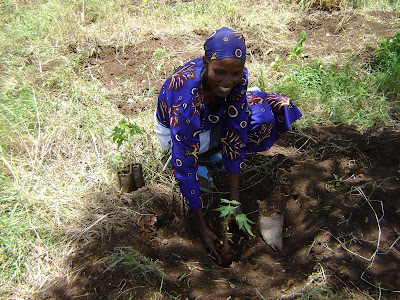
Plant a tree!


The long rains are upon us, and have been for a while fortunately, so tree planting has been in full swing. With Earth Day 2010 looming, this seems like a good time to talk about the multi purposes and endless benefits of trees in Tanzania.

First, the macro benefit. Simply put, trees breathe in carbon dioxide, which poisons the air and contributes to global warming, and breathe out oxygen which is essential for life. It thus makes good sense to plant trees and use them responsibly.

Popular trees around here include fruit trees like guava and papaya which contribute to a healthier diet. Cassia trees provide shade and firewood, and serve as a windbreaker to control soil erosion. They beautify the environment with their bright yellow flowers.

Croton Megalocarpus provide building materials, live fencing, firewood, fodder, shade and medicine. Their leaves enrich the soil.

Grevillea Robusta are widely used among farmers for agroforestry because they grow fast, help control soil erosion, don't compete against food crops for nutrients and sunlight, and their leaves help to replenish the soil. They also attract bees. Other uses include firewood and timber.

The Acacia family is amazing. Acacia Drepanolobium, the mbalimbali tree, supplies firewood, fencing material, goat feed and is used to construct toilets. Acacia Xanthophloea, also known as the fever tree, is a source of building materials, live fencing, fencing posts, firewood, fodder, soil improvement through nitrogen fixing, and medicine. Acacia Tortillis, the umbrella thorn, is great for hosting bee hives, live fencing, fibre (rope), firewood, construction of furniture, tool handles, needles and even dye.

Manihot Glaziovii is a drought resistant species that provides shade and serves up vegetables during the lean season.

The Neem tree in addition to providing magnificent shade is used as a natural pesticide and has multiple medicinal uses.

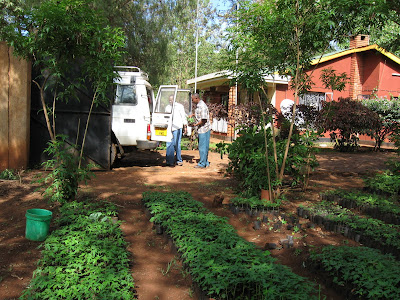
Firewood is the main source of energy in rural households so ongoing tree planting is vital. People understand that. There is a big demand for seedlings. We have a tree nursery in our office compound which is becoming increasingly popular.
Monday, 22 March 2010

World Water Day 2010


Kids and rainwater at Mikocheni Primary School

Water! Here in rural Tanzania, we think about it and we worry about it constantly. Happily, it rained heavily on Saturday night and again last night. We were concerned that "the rains" had stopped in which case farmers, food production and the entire Karatu water supply would have been in trouble. Now it seems that "the rains" just might be continuing... but of course we can't be sure.

The theme for this year's World Water Day is "Clean Water for a Healthy World". Our Rainwater Harvesting project in rural primary schools harvests rainwater off school rooftops to provide clean water for drinking and handwashing which can then be recycled for cleaning classrooms and latrines, and planting trees.

Under our Food Security program with local farmers, we will be exploring other cost-effective forms of rainwater harvesting, such as plastic-lined open storage "tanks" made of earth, and the use of simple water technologies like treadle (foot operated) pumps to lift water from its source, and gravity-fed drip irrigation systems using tubing and buckets. We are presently training groups of women in Kambi ya Simba village to use these micro irrigation technologies to create large vegetable gardens. More on that later...