Friday, 15 May 2009

Haraa Primary School Update


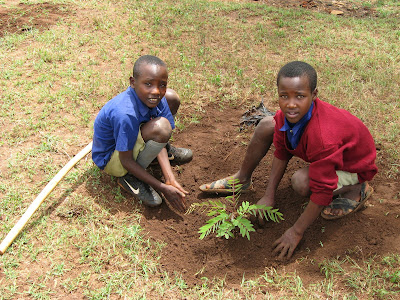
With funds raised in Canada during CPAR's World Health Day Challenge campaign, work is well underway at Haraa Primary School to construct two 30,000 liter rainwater harvesting tanks. The community has gathered local materials -- rocks, gravel and sand -- used in the construction activities, and community members are hard at work digging the pit for the Ventilated Improved Pit (VIP) latrine to be constructed next. We delivered gutters to the school and met three boys carrying water, which is unusual and actually kind of refreshing since girls are normally sent off on this grueling chore. Both teachers and students are looking forward to having water on site.

Thursday, 14 May 2009

Still Baking


The women at UMATU are really getting into baking. Today they made bread, buns and a carrot cake. After a bit more practice, they'll be ready to scale up and open their bakery to the Karatu public. Here at CPAR, of course, we've already dived into UMATU's mighty delicious and very filling bread in a big way.

Tuesday, 5 May 2009

Bread


What a great day! UMATU women (and CPAR staff) learned how to make bread, quite literally from scratch. We started out by visiting the local market to buy wheat grown in nearby Mbulu Mbulu. We visited several stalls before we bought a debe (big bag) of really good looking wheat. Our next stop was the milling shop to get the wheat winnowed (separating the chaff from the grain) and ground into flour. Then we headed back to UMATU's spacious kitchen. After carefully measuring out the ingredients, we got into some serious dough preparation. The result was six beautiful loaves of golden, fragrant -- and healthy -- bread! Nderingo says it's the best bread he's ever tasted. UMATU's bakery is officially launched!

Wednesday, 22 April 2009

Earth Day 2009


Today is Earth Day and the Internet is teeming with tips on “living green”. Earth Day Canada’s Top Ten Actions include tips like:

Buy what you need, not what you want
Replace indandescent light bulbs with compact fluorescent bulbs
Walk, cycle, car pool or use public transportation
Support local food producers
Hang your clothes to air dry
Take short showers instead of baths
etc., etc.

It’s interesting to compare living “green” in Canada with life here in rural Tanzania. For one thing, people constrained by poverty are hard pressed to buy the things they need much less those things they really want so that addresses tip number one. Most of the light bulbs used in Karatu are fluorescent energy saving bulbs because electricity is so expensive that people have to take measures to keep their costs down. Lights here don't go on until it is truly dark! Oh, and that's only about 5 per cent of Karatu's population -- 95 per cent don't have access to electricity.

Less than three per cent of people in Karatu own vehicles, and public transport is a constant struggle so the vast majority of people bicycle or walk great distances. Most of the food consumed is grown locally – maize for the staple food and tomatoes, onions, cabbage, carrots and green peppers for the stew. The bananas for dessert are grown only 20 km down the road in Mto wa Mbu. All the animal products – beef, chickens, eggs, pork – come straight from local farms.

Doing your laundry in Karatu means filling a basin half full with water (a precious commodity that must at all times be conserved), washing all your clothes by hand and hanging them on the line to dry in the sun. Showering involves filling a small bucket with water, soaping up and then scooping up water with a small container to rinse off.

One challenge is the proliferation of plastic water bottles, many discarded by the tourists passing through. Although there are no established recycling facilities, the bottles are recycled informally and used to carry milk, cooking oil and kerosene to meet day-to-day needs. Another challenge is the plastic bags that were introduced in the 1990s. The government has recently banned most of them, but the ban is slow to take effect. UMATU members are presently sewing bags made from local scraps of cloth as an environmentally friendly alternative.

Hmm, all in all... we’d say we’re pretty green...

Tuesday, 7 April 2009

Rain!

Clip art courtesy of DailyClipArt.net

The rains have arrived -- a month late -- but they are finally here! After missing the expected 'short' rains in October-November, the production of food depended on the timely arrival of the 'long' rains in March-April. When March came and went without a drop, we feared watching crops wither in the fields and the need for Food Aid in Karatu District. A huge burden has been lifted and the transformation from fear and resignation to smiles and celebration is truly great to behold.

Monday, 30 March 2009

Tour d'Afrique 2009


Cyclists with this year's Tour d'Afrique passed through Arusha this month on their annual bike safari from Cairo to Cape Town -- Arusha is the halfway mark. The Tour presented 7 California bicycles each to UMATU, ALPHA (Arusha living positive & with HIV&AIDS)and MIHV (Minnesota International Health Volunteers)for their health outreach activities. Here's a photo of UMATU and ALPHA members with the bikes at Masai Camp in Arusha. Meanwhile, back in Karatu, MIHV volunteer Sarah is training UMATU members in sewing and beadwork. They are starting to produce really cool bags, purses and 'spicey' potholders filled with cloves from Zanzibar.

Tuesday, 24 February 2009

World Health Day Challenge 2009


CPAR is gearing up for this year's World Health Day Challenge on April 7th. We invite Physicians and other Health Professionals to donate all or a portion of their proceeds on that day to support community development projects like the establishment of safe water and sanitation facilities at Haraa Primary School here in Karatu District.

We asked the Haraa school kids about their current water situation.

“The water source is very far from school, and the water is really dirty and contaminated. We use the same source as livestock, and that is not very good for our health.”

“This water source is seasonal, and when it dries up we have to go far into the forest to fetch water and in this forest there are wild animals which are dangerous to our lives, animals like elephants and hyenas, and this forest is more than 6 km from school, up in the hills so we spend more than 4 hours going there, which can affect our academic performance.”

"We walk a long distance to the water source and then back with a bucket load of water on our backs or on our heads. During the dry season, the problem becomes more serious because we have to walk several kilometers to the forest to fetch water. We can get harmed by wild animals and that’s why we need water here in school.”

Please check out our World Health Day Challenge website at www.donateaday.ca