Wednesday, 16 October 2013

Women's Rights are Human Rights

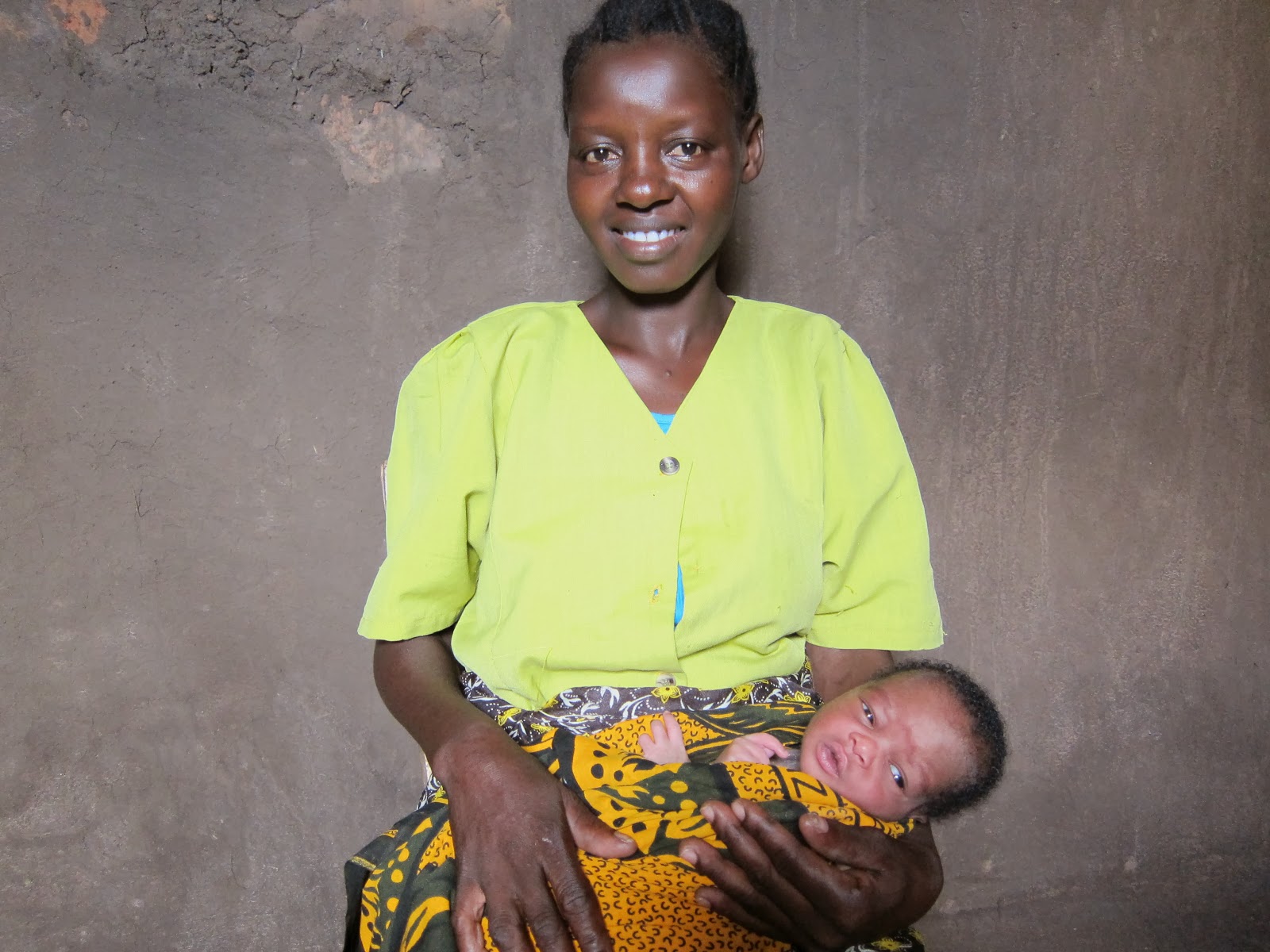
Angela Lucas, Farmer Field School member
Today is Blog Action Day, with a Human Rights theme, and World Food Day.  We appealed to our Bunda project officers, Mona Mapunda and Scolastica Mwema, for a ‘human rights’ story related to their work with Food Security and Farmer Field Schools.  They decided to go with ‘women’s rights’ are ‘human rights’ and shared an example of what should happen when men try to  meddle in women’s personal choices and decisions.  They describe a scenario where a ‘brother-in-law’ was trying to prevent his ‘sister-in-law’ from participating in a Farmer Field School.   

Angela Lucas (pictured above) lives in Sarawe village in Bunda District.  She joined Jitegemee Farmer Field School (FFS) in December 2012 and became a very active member with the goal of learning and practicing new farming techniques and increasing her household food production.  Angela’s brother-in-law, who shall remain anonymous, decided that she had no business being in the FFS group and tried to drive her out by undermining her among the other members.

By this time, Jitegemee FFS group had two specially trained local facilitators, one woman and one man, and all members had participated in CPAR’s human rights and gender equality training.  The members called an emergency group meeting to tackle the issue head-on.  Local FFS facilitator Catherine Jeremiah (pictured below in the group meeting) spoke to the group about Angela’s basic human right to be a group member, and Angela and the other women confidently claimed Angela’s right to be there.   
Local FFS Facilitator Catherine Jeremiah and members at the group meeting
As Angela notes, “misunderstanding and conflict exist in any society but now we have the ability to discuss together and restore peace.” She adds with a smile, “that being said, I have every right to stay in this group and I will never be thrown out.”
This story serves to underscore the importance of human rights education for all.  Human rights are innate and inalienable.  They resonate with people and propel them to take action, as happened with Angela, Catherine and their FFS group. 
 
 
“Before our human rights and gender equality training, women had no voice and no control over anything, we were treated like animals.  Now things are changing.”

Sunday, 19 August 2012

Farmer Field Schools and Yustina Sebastian

Yustina Sebastian with three of her kids
When CPAR first arrived in Bunda District near Lake Victoria to collaborate with local government and rural communities, farmers identified low production of food crops to be a major challenge in their struggle to attain food security. CPAR responded by facilitating the establishment of Farmer Field Schools (FFS).  

FFS is a group-based learning process or ‘school without walls’ that builds on farmers’ existing knowledge and experience. The farmers themselves choose the problems they want to work on and come together in the field, on an experimental plot, to experiment, observe, discuss, analyze and adapt farming methods to suit their own particular environment.

The farmers themselves lead the process, initially with a CPAR FFS facilitator, meeting on a regular basis over the course of one full cropping season to make regular field observations, relate their observations to the ecosystem and apply their previous experience and any new information to make crop and livestock management decisions.  They apply the knowledge gained from the experimental plot to their plots at home.

Although originally established as a season long process after which members would ‘graduate’, in reality FFS groups having experienced the benefits of working together as a group tend to choose to stay together and move on to establish savings groups and initiate other activities.
Yustina and two of her kids in her cassava field
Yustina Sebastian is a smallholder farmer in Haruzale village in Bunda District. She struggled for years to produce enough food for her family and often had to resort to casual labour to get food for her five children during the lean season (the period before the next harvest).

Yustina joined her FFS group in October 2010 and, among other things, learned about short maturity cassava which takes about five months to mature. She is now harvesting cassava, a staple food, in under a year. With material support of improved drought resistant seeds and the application of conservation agriculture methods and sound agronomic practices learned in her FFS group, Yustina has been able to increase her maize production from 5 bags to 12 bags per acre, worth an additional $400. Her goal for now is to keep her children -- Efrasia(8), Anastazia(10), Pius(12), Deonatus (14),and John (16) – healthy and in school. 

Friday, 18 November 2011

Bringin' home the bacon!


Women farmers here in Karatu want access to livestock because livestock can be a lucrative business -- a mature pig of around 80 kgs can fetch $170.  To respond to their priorities, CPAR Tanzania launched a pig campaign last Christmas.  Here's what has happened since:

In collaboration with local agricultural extension officers, we provided training in pig management to 80 women – 21 of whom are heads of their households.  Topics covered included types of pigs and their selection, caring for pigs and piglets, feeding and pig nutrition, simple pig house construction using local materials,  parasite and disease control,  marketing, price negotiation and record keeping.

After constructing their pig houses, 80 sows and 20 boars were distributed to the women in their communities -- Kambi ya Simba, Kilimatembo and Rhotia Kainam.  It's uneconomical -- well, not just uneconomical -- to match one boar to one sow, so we organized one boar for four sows.    The women responsible for the boars ensure that they're in good health to provide quality services to the sows, while the rest of the women bring their sows once they show signs of being in heat.
With proper management, a boar can service sows for  up to 5 years after starting the mating process.  After that, the boar will be too weak to mate and produce healthy piglets.  At that point, the women caring for the boars can sell them for not less than $200 each.  
Each woman is responsible to train and pass on two three-month old female piglets to another woman who in turn is required first to construct a pig house.   So far, an additional 80 women have been selected -- doubling the initial project investment -- and the pig passing has begun with 20 women receiving piglets.   This 'pay it forward' principle will continue.

Cash in the hands of women leads to paid school fees, more nutritious food and healthier happier kids.  After that, a common priority is to lay the foundation and get started on constructing a modern house.  

Saturday, 8 October 2011

World Health Day Challenge 2011 -- Mother and Newborn Health

Bunda was abuzz this past week with training for Traditional Birth Attendants (TBAs).  CPAR Tz staff  teamed up with Bunda District Health Department to deliver a dynamic workshop for 32 TBAs from 14 rural communities.  

The ‘Continuum of Care’ approach to Mother and Newborn Child Health recognizes that the health and well-being of women, newborns and children are closely linked and need to be managed in an integrated manner.   It ensures that the health care needs of women and their children are addressed from pre-pregnancy on through the early years of a child’s life.  The first dimension of the Continuum is ‘Time’ -- from pre-pregnancy through pregnancy, childbirth and the early days and years of life. The second dimension of the Continuum is ‘Place’ -- linking home, community and health facilities.


The purpose of the training was, first of all, to emphasize the importance of TBAs providing education in their communities and linking pregnant women with their local health centres to allow for early screening of complications and the four visits necessary for the full range of antenatal services and delivery.   They learned about the importance of a Birth Plan for every pregnant woman, and about the development of referral plans.  They learned about PMTCT (Prevention of Mother to Child Transmission of HIV).

In the event of unforeseen circumstances where a TBA must perform a delivery, the training focused on the elements of a clean, safe delivery.  (Although pregnant women are encouraged to deliver at the health centre, in reality in Bunda around 70 per cent of pregnant women deliver at home.)

TBAs learned about recognizing and responding to danger signs during pregnancy, delivery and immediately after delivery (e.g. the most common emergencies are hemorrhage and birth asphyxia).  The mother must be visited within the first 24 hours of delivery, and again within 24-72 hours to examine mother and child for bleeding and infection.  The TBAs learned the basics of hand washing, clean cord care and a clean cloth to wrap the baby.  They discussed the importance of immediate and exclusive breastfeeding.  Other important topics were Immunization and Family Planning. 
Training aids included babies and pelvic models...

The TBAs were provided with safe delivery kits equipped with razor blades, soap, sterile gloves, string and a rubber mat.   

TBA Leticia Mussa receives her safe delivery kit


The TBAs also received bicycles which will help them reach pregnant women for education, counseling and referral plans.
TBA Subyeki Eliasi with her new bike
TBAs offer a great entry point for education – for example, engaging pregnant women in discussions about malaria and use of bednets for both the women themselves and children under the age of five can have a huge impact on Mother and Child health.    

Tuesday, 29 March 2011

World Health Day Challenge 2011

Leticia Mussa with one-week old baby she delivered
CPAR's 6th Annual World Health Day Challenge is coming up next week on Thursday, April 7th -- World Health Day!  We invite health professionials and other interested people to donate a portion or all of their day's income to support safe motherhood in rural communities in Bunda District.  Please  Donate a Day for Africa!   

We will be collaborating with Bunda District Health Department to provide training for Traditional Birth Attendants (TBAs) like Leticia Mussa (check her out on You Tube) .  Their key role will be stressed as one of identifying pregnant women in their communities, providing them with education and information, helping them prepare Birth Plans, encouraging them to deliver at the local health facility and assisting them with a strategy to get to the local health facility.  The role of men will be strongly stressed.

Very importantly, TBAs will be trained to identify complicated pregnancies for early referral to Bunda District Hospital, and they will learn about PMTCT (Prevention of Mother to Child Transmission of HIV) and how to protect themselves.  We will provide TBAs with safe delivery kits equipped with sterile gloves, aprons, plastic sheeting, razor blades, soap, string to tie the cord, etc.  Although the jury is still out in Tanzania on the official role of TBAs in "safe motherhood", the fact remains that over 60 per cent of rural women give birth at home.  Our goal is to make sure that this happens safely.

Tuesday, 22 March 2011

World Water Day 2011

Meet Sikitu Joseph (left, in yellow), Farmer Field School (FFS) Facilitator and member of Haruzale Water Committee, the body responsible for managing and maintaining Haruzale's Community Borehole (deep well) established by CPAR last November.  We visited Haruzale last week and talked to Sikitu about the impact the borehole has had on her day-to-day life.

Sikitu used to walk 5 km to Lake Victoria twice a day -- at 6:00 a.m. and again after lunch -- to fetch a bucket of green, slimy, contaminated lake water for her family's needs.  Each trip would take from 2 to 3 hours.  Sometimes she would go by bike and carry 2 buckets at a time. 

Now with the borehole nearby, Sikitu spends more time focusing on her farm and conducting small business activities to generate cash -- she sells mandazis (donuts) and eggs and uses the money for her kids' school needs and household items like kerosene and cooking oil.  But the big thing for Sikitu is her time and effort saved -- spending hours every day carrying heavy loads of muddy water is unpleasant and exhausting.

Crucial to the long life and success of the borehole is the management style of the water committee -- 3 women and 3 men selected by the village government.  In Haruzale, each of the 200 households served by the borehole contributed about 70 cents towards opening a bank account for the borehole.  Now each household is required to pay the equivalent of 35 cents every month.  This money is deposited in the borehole bank account and will be used to service and, when necessary, repair the borehole and the pump.  Each household is also required to contribute about 15 cents every month to pay for the security guard appointed by the water committee to watch over the borehole.  To save wear and tear on the pump, the operating hours are from 7am to 12 noon, and again from 2pm to 6pm daily.  The security guard makes sure the timetable is followed.  Sikitu and the other water committee members are confident that their borehole is going to be in operation for a very long time.

Friday, 25 February 2011

Energy Saving Stoves


Learning how to construct energy-saving stoves
Women in rural communities have to walk increasingly long distances to look for firewood. This is a tedious, time-consuming burden for women and girls and detracts from time spent in girls going to school and women participating in activities that will generate income.  From an environmental perspective, the use of large amounts of firewood for cooking has contributed to problems of deforestation leading to soil erosion and land degradation -- undermining agricultural efforts to produce food.

three-stone fire
The local three stone fireplace is the most common method of cooking in rural Tanzania. It is easy to construct and requires no investment of time or money. It uses a wide range of fuel sources but a lot of heat and fuel are wasted, a considerable amount of smoke is produced and children are prone to serious accidents due to the open features of the fireplace.

Back when CPAR Tz first started working in Karatu District, we learned that various models of energy saving stoves had been introduced but none had been widely adopted. We wanted to promote energy saving stoves because they use about one-third the firewood of the three-stone fireplace, so we decided to consult with rural women to find out why the stoves weren’t popular.The women complained that they couldn’t roast maize, the stoves didn’t produce enough light and the intensity of the heat tended to destroy their pots. Furthermore, they were expensive to construct because they used cement and burnt bricks. And, the women objected to the use of chimneys because, as they pointed out, a little smoke is a good thing to keep snakes and scorpions out of your house.

CPAR Tz shared this information with women from the Arusha-based Centre for Agricultural Mechanization and Rural Technology (CAMARTEC) who had already worked to design an energy saving stove that addressed women’s concerns. In addition, they had taken “kitchen management” to a whole new level by tackling women’s comfort and efficiency in the kitchen.
  
Testing the soil
Since that time, we have promoted mud cookstoves (“Mkombozi”) that women can build and maintain themselves using locally available materials -- clay soil or ant hill soil, fresh cow dung, “lomay" (a local tree that produces a jelly like substance used as a binding agent), gravel and water.
                  
Mixing the goop
 These same local materials are used to construct stools so that women can sit comfortably while cooking, and can be used to construct shelves so that kitchen utensils can be tidily stored and easily accessible.

Using wood and paint containers

The tools required to construct the stoves are a knife or machete, a bucket, two pots or paint tins of 5 liter capacity and a piece of flat wood for compacting the soil. With the exception of the paint tins and flat wood, all are readily available at the household level. The paint tins and flat wood can be procured for about $2 and then continuously recycled to other households. All the necessary measurements are calculated using one’s hands.


As part of the “kitchen management” training, women learn to keep the kitchen clean, arrange kitchen items conveniently, maintain the stove, store firewood properly, keep cooking utensils covered and sprinkle the earth floors with a bit of water before sweeping to minimize the dust. They learn energy saving tips such as reducing the firewood once the food has come to a boil, covering the pot with a lid whenever possible, avoiding overcooking, soaking raw foods such as maize and beans before cooking, chopping certain foods into small sizes before cooking, using dried wood for less smoke and better use of energy, and preparing everything first before lighting the stove.

Traditional Iraqw houses don’t have windows so cooking over the three-stone fire fills the house with smoke. The Mkombozi stoves are constructed, at women’s request, in place of their three-stone fires. It’s easy to see on the mud wall exactly where the smoke hits so, keeping in mind that some smoke in the house is desirable, the women are encouraged to put in a small window so that a lot of the smoke can escape.

Demonstration -- although this pot should ideally be covered...

Cooking stew and roasting maize
Results from using the energy-saving stoves include use of 3 sticks of firewood instead of 10; faster cooking times; the ability to leave food cooking on the stove and tend to other activities; far less smoke leading to a reduction in eye inflammation and respiratory problems. One unexpected result was that some of the women trained have been able to turn their new skills into an income-generating activity.  Our most recent training was facilitated by Rosalia, one of the first women trained by CPAR Tz in 2004.  She even makes small modifications to the stove to make it more user friendly, e.g. making the burners two different sizes to accommodate the variety of pots found in households.

Rosalia (left) instructing Sabina


Wednesday, 15 December 2010

The "Face of Giving"...

 
This little piggy's going to market...
We've launched a "Pig Campaign" this holiday season to raise funds to purchase pigs for women's income-generation in Karatu District. Our goal is to buy 110 pigs -- 90 female and 20 male -- and distribute them to 90 women in the communities of Rhotia Khainam, Kilima Tembo and Kambi ya Simba. Cdn $70 per pig includes purchase, transport, training, and follow-up and monitoring by CPAR field staff.

Women’s income-generating is an important component of CPAR’s Food Security Project. Our rural women partners want livestock to generate income – specifically pigs and dairy goats. Before they receive the pigs, we train the women in pig husbandry – how to care for the pigs, what to feed them, how to prevent and treat conditions like worms and foot & mouth disease – and the women are required to build a simple pig house out of locally available burnt bricks or thatch.

Nderingo with Rebekah Lazaro and her pig
Each woman receives one female pig, and the male pig is shared among five households or so, depending on their geographical location. The gestation period of a pig is 114 days – poetically 3 months, 3 weeks and 3 days. One litter is usually 8 to 12 piglets, and pigs can have 2 or even 3 litters in one year. One 90 kg 8-month old pig can fetch Tsh 270,000 (about Cdn $260), and they are immensely marketable in Karatu, Arusha and as far away as Dar es Salaam. Pork is popular!

CPAR's “Pay it Forward” principle requires each woman recipient to pass on 2 female pigs and training to two additional women. Considering that the average annual income of many households is only Cdn $288, pigs are an excellent boost to household cash. And, it's a well known fact that when women have access to cash it goes to support children's education, buy food for the household and improve the health of the family.

Our goal is to raise Cdn $7,700. Please visit CPAR's Face of Giving website today to purchase a pig and put cash in the hands of women.

Friday, 15 October 2010

Blog Action Day 2010: Water in Tanzania

Today is Blog Action Day 2010, and thousands of bloggers all over the world are blogging to draw global attention to the vital human right to safe, clean water. It is appropriate that we -- CPAR Tanzania -- should be blogging about water today because as we speak community members of Kerekekere village are accessing borehole water for the first time ever, and we have commenced drilling of another borehole at Haruzale village.


Members of Kerekekere Water Committee training in borehole maintenance


First borehole water at Kerekekere
Water is a huge challenge in rural Tanzania, so we've been taking a variety of approaches to supporting communities to meet their water requirements. This includes construction of rainwater harvesting tanks in primary schools; micro-irrigation schemes for women's vegetable and fruit gardening; and most recently support for community boreholes.

Words don't do justice when describing the kinds of water sources people are forced to turn to for their daily needs of drinking, cooking, bathing, handwashing, doing dishes and washing clothes. So, here are some shots...


Fetching water for home use
 
School kids fetching drinking water

Washing dishes and bathing in Lake Victoria
We are committed to supporting community solutions to water challenges and, as long as we can continue to obtain funding (the challenge of every non-profit organization), we will keep plugging away at the local level and telling you about it on this blog.
School kids drinking rainwater
In the meantime -- don't waste water, be grateful for the luxury of drinking from the tap and please feel free to donate to CPAR Tanzania through our website at Canadian Physicians for Aid and Relief 

Friday, 24 September 2010

Boreholes in Bunda!


We have ventured into new territory. After six years of building rainwater harvesting infrastructure in primary schools in Karatu District, we are taking a different approach to address water challenges in Bunda District. Subsequent to hydrogeological and environmental assessments of Bunda, located in the Lake Victoria watershed, boreholes (deep water wells) are found to be a feasible solution to water problems faced by our project communities.

Karukekere village is a farming community about 8 km from Lake Victoria which is the largest lake in Africa, divided up among Kenya, Uganda and Tanzania. (As a point of interest, the White Nile flows out of Lake Victoria at Jinja, Uganda.) Karukekere community members have depended on seasonal sloughs and water from the lake -- both contaminated -- to meet their water needs.

As Japhet, Nderingo and Elizabeth were on hand in Karukekere, pretty stressed out as we all waited for the drillers to strike 'gold', all of a sudden water erupted (see the photo above). Actually, any water project is stressful. With rainwater harvesting, we anxiously await the rains. With boreholes, even with the best information, there's still no iron-clad guarantee that you're going to end up with a reliable source of good quality water. That being said, things are looking very good at Karukekere as we await the results of the water analysis.

Drilling is but one component of a water project. How the water will be used is the really important focus. Tanzania's National Water Policy stipulates that every water point must be managed by a Water User Group (WUG). The WUG, made up of local women and men, ensures that the water source is used effectively and efficiently, and is conserved, protected and maintained. The WUG mediates any disputes that might arise and the members serve as representatives at District and Catchment level. CPAR is collaborating with Bunda District Water Department to train and support the Karukekere WUG, and we will then turn our attention to promoting good sanitation and hygiene practices.

Sunday, 30 May 2010

Kildonan-East Collegiate - Tanzania 2010


It's been a long time coming... but after four years of global education in the classroom and inspired fundraising for our school rainwater harvesting activities, 18 students, 4 teachers and 7 family members from Kildonan-East Collegiate in Winnipeg finally arrived in Karatu to meet the kids, teachers and parents of Qaru Lambo and Gilala primary schools, and experience some things that life here has to offer.

Our first stop was Qaru Lambo Primary School where the Kildonan and Qaru Lambo kids got to meet each other and hang out for a very full, wonderful day.


Everybody signed the school guestbook, visited all the classrooms, the students sang and the whole community got involved. They welcomed our guests with a sumptuous lunch and celebrated with drumming and dancing.


The Kildonan students reciprocated with a resounding rendition of the "Hokey Pokey". Hey, you can't go wrong with the "Hokey Pokey".


By the end of the day, the Qaru Lambo kids and the Kildonan kids were playing competitive games of soccer, volley-ball and netball.


And that was just the start of the adventure. Check out Kildonan's blog of their experiences at KEC Tanzania 2010

Friday, 7 May 2010

Micro Irrigation at Work!


Farmer Field School women's groups in Kambi ya Simba are in the process of establishing large vegetable gardens and fruit orchards with the help of micro-irrigation equipment. Treadle pumps like the MoneyMaker pump and simple drip irrigation schemes can revolutionize production in arid areas dependent on rainfall.

As the women tested the pump, pumping water from a nearby stream, they were amazed at the velocity and reach of the spray.


Operating the MoneyMaker pump is kind of like working out on a stairmaster, and the school boys love it... at least, they do now until the novelty wears off.


Drip irrigation is very simple. A large bucket is placed on a stand, and lines of plastic tubing are laid throughout the garden. Water is applied (or "dripped") on a slow, even basis at root level so very little is wasted through evaporation or run off.


Simple, but very effective considering the time-consuming, tedious alternative of fetching bucket after bucket of water from the nearest water source to water by hand.

Gilala Primary School


Work is almost complete at Gilala Primary School, the second school supported by the students of Kildonan-East Collegiate in Winnipeg. Rainwater harvesting tanks have been constructed and the VIP latrine is a work in progress. Our CPAR Tz colleague Japhet Emmanuel was in Winnipeg recently where he met with Kildonan students to discuss the impact all their efforts have had on school children's lives in Karatu and to further prepare them for their upcoming visit to Tanzania. Check it out at Japhet in Winnipeg